Welcome and thanks to the Columban priests who will be celebrating 8.30am and 10.30am Masses and Baptisms this weekend.
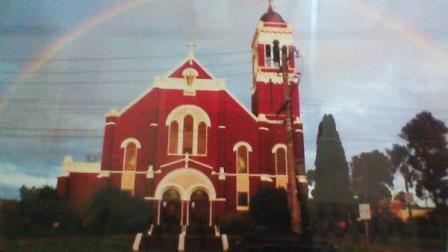
CENTENARY CELEBRATIONS FOR SACRED HEART PARISH, PRESTON
JOIN AN ‘ENCOUNTER’ TO EAST TIMOR OR KIRIBATI WITH PALMS AUSTRALIA
A Catholic organisation which has been preparing, placing and sup- porting skilled Australian volunteers in placements in Asia, Africa and the Pacific for 50+ years. A Palms Encounter is perfect for anyone interested in learning about another culture, as well as those interested in social justice and reducing poverty. Dur- ing this cross-cultural experience, you will gain insight into the life of work of Palms’ volunteers, and learn about the pressing development issues facing our neighbours. Dates are 14-26 April 2014 and 26 July-7 Aug 2014.
For further information visit: http://www.palms.org.au/encounters, email: encounter@palms.org.au, or call Palms on 02 9518 9551.
Limited places remain as numbers are restricted to ~8 per Encounter.
CATHOLIC STEWARDSHIP
CATHOLIC STEWARDSHIP FROM SUNDAYS READINGS
“You are the salt of the earth… You are the light of the world.” With those two short sentences, Jesus reminds us all of our Baptismal and Stewardship callings. It is important that we remember that these two brief sentences occur in Holy Scripture just after the Lord has taught us the Beatitudes, “Blessed are the poor in spirit… Blessed are those who hunger… Blessed are the merciful.”
Today’s Gospel reading is a small part of Jesus’ longest oration in all of Holy Scripture — His Sermon on the Mount. In so many ways this Sermon is a stewardship presentation. If we just focus on the two pieces of advice the Lord gives in the four verses of today’s Gospel, we go a long way to both understanding and achieving stewardship.
If we bring meaning and enhancement to the lives of those around us (salt), and if we provide love and joy to them (light), we will have gone a long way to fulfilling what Jesus has exemplified that we must do. We will indeed have responded to Him as He wished — as disciples and stewards. Shakespeare even understood this thought as he wrote in the Merchant of Venice, “How far that little candle throws his beams. So shines a good deed in a weary world!
Copyright © 2014 www.TheCatholicSteward.com
REFLECTION ON TODAYS READINGS – SISTER VERONICA LAWSON rsm
Reflection on the Gospel-Fifth Sunday in Ordinary Time Year A, 9 February 2014 (Matthew 5:13-16)
In today’s gospel, Jesus addresses two short parables to his disciples in the presence of the crowds. The crowds as well as the disciples hear what he has to say. Parables were intended to tease their hearers, inviting them to see things differently or from a new perspective, to see themselves in a new light. One of the difficulties for us is that Jesus told these parables in early first century Palestine with its particular symbol system, while we hear them through the multiple layers of our own twenty-first century contexts and symbol systems. ‘Salt’ and ‘light’ have slightly different resonances in different contexts, as do ‘earth’ and ‘world’. Exploring those resonances or nuances can bring us to a deeper appreciation of the text.
This short reflection allows for a focus only on ‘the salt of the earth’ parable or metaphor. For Jesus’ Palestinian audience, salt was used to preserve and season food. It also functioned as a cleansing or purifying agent. It could only lose its savour if contaminated by additives. We can resonate with all of that. For some of the Jewish rabbis, salt signified wisdom: a ‘salted’ disciple was a ‘wise’ disciple. In some parts of the ancient world, as in Pakistan today, salt was used in dyeing processes as a way of intensifying as well as preserving the colour of fabrics. Many Westerners are not aware of this practice. Farmers today are rightly concerned about high levels of salinity in overworked soil. That was certainly not the case for first-century Palestinians.
When we declare someone to be ‘the salt of the earth’, we are generally referring to the sheer goodness of the person in question, her/his down-to-earth reliability, lack of pretentiousness and practical wisdom. To be salt of the earth is to season the earth community, to intensify its beauty, to be wise in one’s judgments, and just in all one’s dealings. This parable, with its multi-layered symbolism, certainly teases the mind.
In the original Greek, the emphasis is on the first word in the sentence. Jesus is telling his hearers, disciples and crowds, that they are the salt of the earth. They do not have to become the salt of the earth; they are the salt of the earth. In short, he is affirming their worth. In its literary context, that assertion contrasts Jesus’ followers with those who might persecute them. It affirms their capacity to stand strong in the face of opposition, ‘for the sake of justice’. If they allow themselves to be overwhelmed or their commitment to be shaken, then the ‘salt’ will be contaminated and the ‘earth’ cannot be seasoned.
LIVING THE JOY OF THE GOSPEL
In Pope Francis’s exhortation Evangelii Gaudium, he talks of ‘joy’ as a requirement for evangelization, and how ‘personal dialogue’ is needed for any authentic invitation into the faith. He says trying to spread the Gospel without personal encounter with Jesus is useless. On the Welcome Desk in St Anne’s Church is a 2014 Calendar of events run by the Archdiocese. You are very welcome to take a copy.
PARISH COORDINATING TEAM MEETING
Last Wednesday evening fourteen of us held our first gathering for 2014. We began by praying and then continued to have a very productive meeting with some new proposals including discussion on the Overseas Humanitarian Project as voted on at our Parish Assembly, the Expo of our Parish Ministries on 16 February and a pilot development of several neighbourhoods.
THANKSGIVING ENVELOPES
The envelopes are available for collection this weekend. Please collect you new envelopes at each Mass.
We thank Jim Reilly and the volunteers who collated the Thanksgiving envelopes two weeks ago. Without the support of volunteers, our parish would not be able to function. We are very grateful.
CATHOLIC STEWARDSHIP
CATHOLIC STEWARDSHIP FROM SUNDAYS READINGS
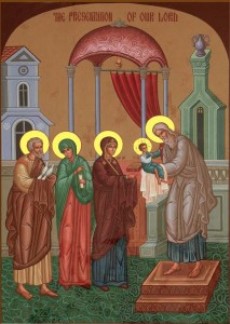
The Feast of the Presentation of the Lord occurs 40 days after the birth of Christ. In Jewish tradition the parents of a baby were to “present” the baby at the temple on the 40th day after birth. This is a celebration that has occurred in the Church from the 300s.
More important to us, as reflected in the three readings today, is embracing the Lord as our Savior, acknowledging that He is both God and man, and striving as good stewards to be like Him in many ways. Notice how Simeon takes the Baby in his arms, holds Him, and declares, “Now, Master, you may let your servant go in peace, according to your word, for my eyes have seen your salvation.”
One of the difficult things for us is to see that same salvation and to go in peace. Stewardship is seeing the glory of our Savior and striving to live out our lives with total trust in Him. As Catholics we need not only to understand our callings, but also to live them out.
St. Thomas Aquinas wrote, “Three things are necessary for our salvation: to know what we ought to believe; to know what we ought to desire; and to know what we ought to do.” Sharing our time, talent, and treasure with God and our parish is what we are to do.
Copyright © 2014 www.TheCatholicSteward.com
REFUGEE POLICY A ‘CAMPAIGN OF CRUELTY’: BISHOP SAUNDERS
The Australian government is in effect conducting a campaign of cruelty towards asylum seekers, the Chairman of the Australian Catholic Social Justice Council, Bishop Christopher Saunders, said on 23 January 2014 ‘The government’s campaign, like that of its predecessors, has only one purpose: to deter desperate men, women and children from seeking protection from persecution and danger’, Bishop Saunders said.
‘The government claims that it is fighting a war’, Bishop Saunders said. ‘If it is a war, then it is being fought against wretched and defenceless people.’
‘We are ignoring the most important issue: the millions of people in our region and around the world who need protection and security.
‘The only hope for a solution to the refugee problem is international cooperation’, Bishop Saunders said.
‘Australia’s policies are undermining and destroying that hope by angering the very nations we need to work with.
‘It seems that friendly relationships with our neighbours are becoming collateral damage in pursuit of an aggressive and callous policy’, Bishop Saunders continued.
‘Can we be surprised if Indonesia is offended when Australian naval ships stray into its waters, or when we ignore its protests and force boats to turn back to their sovereign territory?’
Bishop Saunders quoted recent words of Pope Francis, who said: ‘Migrants and refugees are not pawns on the chessboard of humanity’. The Pope called for us all to move away from ‘attitudes of defensiveness and fear’.
CHRISTMAS MASSES REVIEW
The Liturgy Planning Team met last Wednesday to review Advent and Christmas and to plan Lent.
Firstly, the Mass at Rupertswood Stadium requires immense amount of moving chairs (1650) and gathering liturgical items from both our churches. So to those who came on Friday 20 December at 3pm and 6pm, our thanks we give. However putting the chairs away at 8pm on the night was left to too few volunteers. The dismantling of the altar and removal of liturgical equipment was also done by only a few.
Staging the Mass at the Stadium requires the installation of audio visual equipment with its 3kms of electrical cabling. The sound and vision were very good , costing us $1650.
The Festival of Carols and Readings on 22 December was very well received and will be repeated this year.
PARISH BINGO HAS RESUMED
THE FRANCIS EFFECT
Tuesday 25 February from 8.30am to 4.30pm at Catholic Leadership Centre, Melbourne will be a Colloquium on the Apostolic Exhortation of Pope Francis “Evangelii Gaudium”. More information from Kevin Meese 9639 1344.
CATHOLIC STEWARDSHIP
CATHOLIC STEWARDSHIP FROM SUNDAYS READINGS
Through stewardship we are called to be the light of Christ to others. In today’s first reading from Isaiah, and repeated by the Lord in Matthew’s Gospel is that radiant statement, “The people who sit in darkness have seen a great light.” We are all aware of the joy of light. Of course, this light is much more than just luminescence. This is also the light of understanding and faith, the light to which the Scripture really refers.
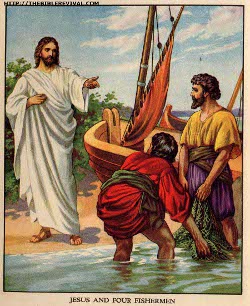
It is worth knowing that the Land of Zebulon and the Land of Naphtali where this light shines was during Jesus’ time in the land of Galilee. Jesus begins His ministry there in fulfillment of the prophecy we hear in Isaiah. There is much more on which we need to contemplate in the Gospel, of course. It begins with Jesus proclaiming the Good News and ends with the Lord calling others to follow Him — specifically, Andrew, Simon Peter, James, and John. These men, who were to become the foundation of the Apostles, provide us with a glimpse of our own callings.
Each of us is called as a disciple, as a steward, of Jesus Christ. Our challenge is to hear that call, respond to it, seek our own vocation, and live it out as good Stewards of the Good News. Where are you in that process? Each of us needs to pursue our Christian calling.
Copyright © 2014 www.TheCatholicSteward.com
REFLECTION ON TODAYS READINGS – SISTER VERONICA LAWSON rsm
Reflection on the Gospel – Australia Day, 26 January 2014 (Matthew 5:1-12)
We have become so familiar with the beatitudes that there is a danger of our listening only to the mellifluous flow of language and of failing to attend to the extraordinary present and future reversal that they offer to those who suffer injustice and to those who choose non-violent ways of addressing it. With the escalation of violence across the globe and with powerful leaders opting for military rather than diplomatic solutions to global conflicts or threats, it is time to listen anew to these opening words of Jesus’ Sermon on the Mount.
The mountain setting establishes Jesus as wisdom teacher like Moses of old. God’s favour rests on the poor, on the gentle, on those who grieve for the pain of the world, on serious justice seekers, on those who know how to mercy, on the pure in heart, on peacemakers, and on those who suffer in the cause of right. The repetition of ‘blessed are…’ (a better translation of the Greek makarioi than ‘happy’) provides multiple links with Israel’s collection of sacred songs, the Psalms. For Israel’s lyricists, God’s favour or blessing is on those whose hope is in God, on those whose delight is in God’s way, on those who take refuge in God, on the guileless in spirit, and on those whom God forgives. The content of the beatitudes echoes the voice of Israel’s prophets, especially Isaiah 61. God’s spirit is upon Jesus. He brings the good news of God’s present and future favour or blessing to the destitute and to those who mourn. The distinguishing mark of God’s favoured ones is righteousness or right relationship.
God’s favour or blessing comes in diverse forms: the basileia or empire of the heavens; comfort in the face of grief; the earth for a heritage; the joy of being mercied; face to face encounter with God; a great reward ‘in heaven’. If heaven is only a place to be enjoyed in the afterlife, it is little consolation for the desperately poor or for those who are persecuted or misrepresented to know that ‘the empire of the heavens is theirs’ or that their ‘reward is great in heaven’. ‘Heaven’ is better understood as a way of talking about God or God’s empire of justice and compassion in contrast with the heartless empire of Rome and its modern equivalents. Maybe the most urgent invitation in our present context is to mourn strategically the displacement of so many of earth’s inhabitants who long for the blessing of God’s kin-dom in the form of comfort and mercy and a share of the earth’s resources.
GLUTEN FREE HOSTS
The Parish is able to offer Gluten free breads to be consecrated during Eucharist. If you wish to receive the gluten free host, please inform the person setting up for Eucharist. The Minister for Communion at the central aisle will have your host in a separate pyx.
CATHOLIC PARISH OF CASTLEMAINE: 160TH ANNIVERSARY PILGRIMAGE TO THE HOLY LAND
As part of its 160th Anniversary Celebrations in 2014, the Catholic Parish of Castlemaine is offering a pilgrimage to Jordan and Israel, Walking with Mary in September this year. Parishioners would welcome pilgrims from other parishes joining with us. Interested pilgrims are invited to an Information Session on Saturday 1st February at 2.00pm in the Buckley Room. Pilgrimage Information Packages are available from Fr Tony Doran PP (Anthony.Doran@cam.org.au or 5472 1900).
PROFILE OF OUR PARISH
The Catholic population grew 9.8% in the years 2006 to 2011 to 13232 persons, 35% of the total population. The number of Catholic households is 5855, where 755 Catholics live alone. The total population of our area increased by 8.6% to 36238.
The number of parishioners requiring assistance in self-care, communication and mobility was 565; those Catholics providing unpaid help were 1252.
Those unemployed were 4%, though those aged 15-24 who are in the labour force and unemployed at the time of 2011 were 8.6% (10.2% Australian average).
Those parishioners born in Australia are 83%; other countries:
2.4% Italy,
2% UK,
1.6% Malta,
1.2% Philippines,
1.1% India,
1% Ireland (21 other countries under 1%)
12% of our families are one-parent families (Australian average ); 56% of couples have mixed religions, 15% are de facto.
83% of families own or are purchasing their homes.
-from material prepared by the Pastoral Research Office of Australian Bishops from census data from Australian Bureau of Statistics
WITHIN OUR REACH: JOY
Friedrich Nietzsche (1844-1900) infamously taunted Christians about the lack of joy on their faces and in their lives. “They would have to sing better songs for me to believe in their Saviour: his disciples would have to look more redeemed!”
Nietzsche the German atheist Philosopher, had a point. Christians can often appear joyless, not joyful. We can literally become ‘killjoys’, murdering the spirit of light heartedness that signifies closeness to God.
There can be a constant ‘moralism’ in some of our Catholic rhetoric that does nothing but bemoan the evils all around us. It is counter-productive and we end up talking to ourselves. By contrast, Jesus attracted people to him with joy – he did not preach ‘at’ his fellow Galileans. If we are without joy, we exude displeasure and are prone to pick fights. Others perceive a hostile streak in us. We can insult people. We lack patience. What flows from our mouths are not blessings but barbs of bitterness.
We lack gratitude. We also lack human warmth and seem to be angry at ourselves and the world. The profile of such joylessness is clear and distasteful: bitter, impatient, pugnacious, hostile, cold and aloof – all ‘killjoy’ qualities. By contrast, as Pope Francis constantly reminds us, Christian joy is buoyant and warm, light-hearted, gracious and life-giving.
….. Br Mark O’Connor FMS, December 2013 Director of Archdiocesan Evangelisation Office
CATHOLIC STEWARDSHIP
CATHOLIC STEWARDSHIP FROM SUNDAYS READINGS
Stewardship calls us to serve others. Stewardship calls us to trust in God. Stewardship calls us to live our lives in reflection of Jesus Christ. Stewardship calls us to be sacrificial in our commitment to God and to those around us.
The readings for this Second Sunday in Ordinary Time echo all of those stewardship elements. Jesus was tempted in many ways throughout His ministry. It would have been easy for Him to become discouraged. Imagine being rejected by society when all you did was love and serve. Yet Jesus does not become discouraged because He trusted in God. As it states in the first reading from Isaiah, “God is now my strength.”
With Jesus’ help, by the grace of God, we, too, can overcome discouragement and many burdens by trusting and by living lives of stewardship. Stewardship is relatively simple: it means recognizing that we have been gifted in multiple ways by a loving God, and then returning a portion of those gifts – our time, talent, and treasure – to the Lord in thanksgiving.
John the Baptist was sent to herald the coming of the lamb. We, too, are called to that noble effort. “Behold the Lamb of God, who takes away the sin of the world.”
Copyright © 2014 www.TheCatholicSteward.com


You must be logged in to post a comment.